



























 Insights, News
 15th July 2026
In the design and furniture industry, innovation isn’t merely about introducing new technologies. It involves rethinking how a company approaches its work, its internal organisation and its environmental responsibility, ensuring that production maturity drives a positive impact, both in optimising manufacturing processes and in enhancing the value of the people behind them.
A transformation rooted in craftmanship culture
It’s exactly on these foundations that the renewal of Frezza’s production area takes shape: an evolution designed to support the company’s growth through more efficient, intelligent and sustainable processes.
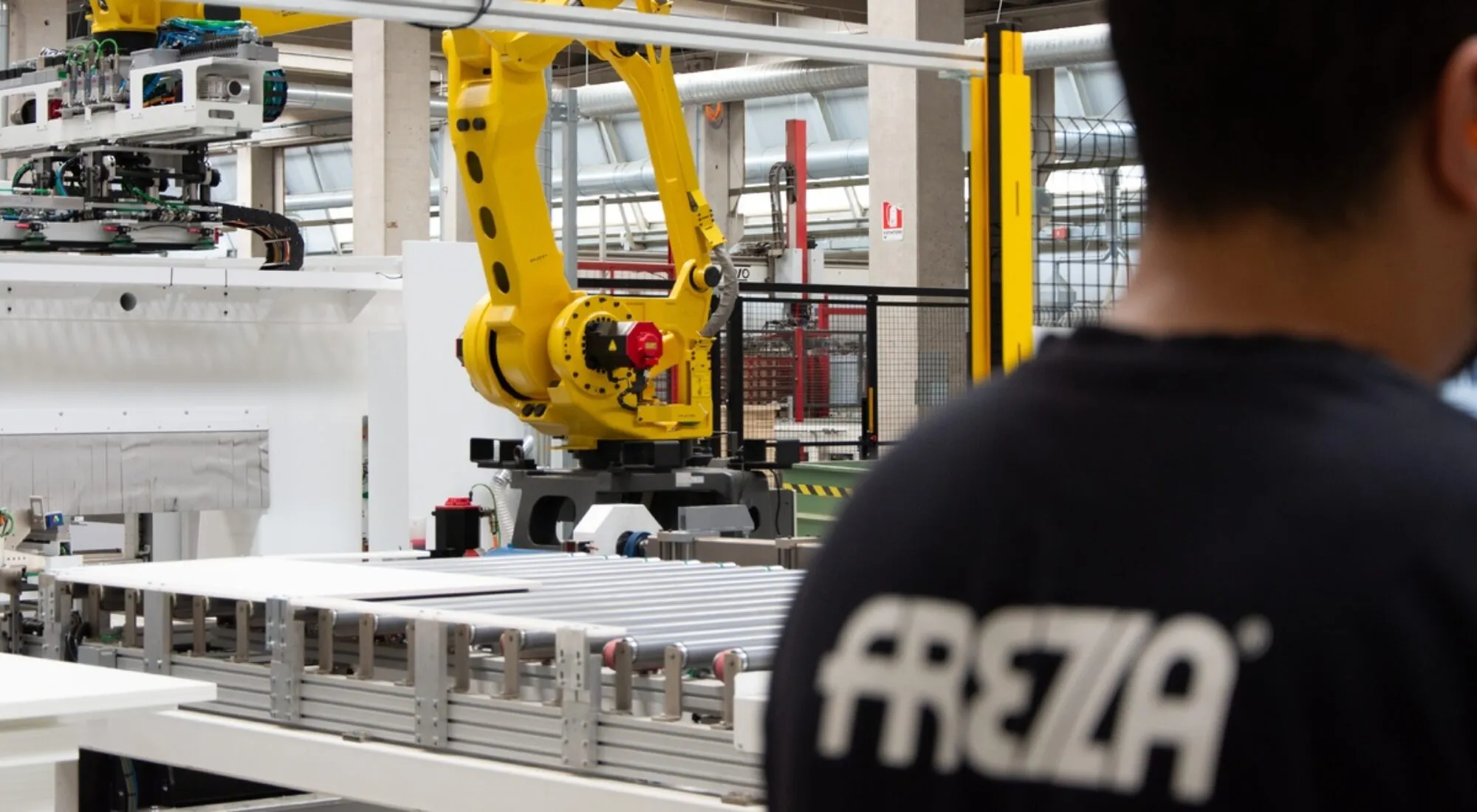
The project encompassed both the machinery fleet and the production infrastructure, with the clear aim of upgrading the department from both a technological and energy standpoint. Rather than replacing the manufacturing heritage that has always defined Frezza, the goal was to enhance it through tools that improve operational coordination and enable more informed management of production activities.
This transformation extends beyond technology to include the way processes are monitored. Today, the ability to collect real-time data represents a strategic advantage, enabling performance improvements, preventing inefficiencies and strengthening operational awareness across the entire supply chain.
The renewal of the production area therefore represents a forward-looking investment that remains firmly rooted in the company’s identity: a balance between digital transformation and industrial culture, where every decision is aimed at supporting people’s work, streamlining processes and generating tangible value.
Digitalisation and IoT: towards an increasingly connected factory
One of the key drivers of this transformation is the implementation of advanced digital systems and IoT technologies within the production department. The integration of smart devices and sensors now enables continuous monitoring of production lines, providing valuable data to supervise and optimise industrial processes while improving efficiency and safety.
Through digitalization, each data point contributes to a clearer and more precise understanding of production flows, making it possible to identify anomalies, inefficiencies and opportunities for real-time improvement. This allows for faster intervention, significantly reducing waste and downtime.
In a well-established industrial environment, however, the introduction of IoT systems requires careful integration within existing structures. The true value of these technologies emerges when they are seamlessly embedded into company processes, enhancing performance without disrupting operational balance. For this reason, the renewal has been designed to ensure continuity between digital tools and human expertise, fostering smoother and more effective collaboration.
The shift toward a connected factory also opens up new opportunities in terms of traceability and process management. Access to accurate, real-time information throughout the production cycle enables the development of more efficient organisational models, strengthens operational control and ultimately improves the overall quality of the final product.
Energy efficiency and sustainability as an industrial vision
Alongside digitalization, the renewal of Frezza’s production area is driven by a clear commitment to reducing the environmental impact of its operations. The gradual upgrading of the machinery fleet has introduced more energy-efficient systems, capable of optimising consumption and enhancing overall process performance.
In this context, sustainability isn’t treated as a separate goal from productivity, but as an integral part of the industrial process. Reducing waste, optimising resources and refining operational organisation all contribute to delivering measurable benefits, both operationally and environmentally.
Production time management also plays a critical role: more streamlined and high-performing processes help minimise energy losses associated with auxiliary activities and product dwell time within the production cycle, generating positive effects across the entire organisation. At the same time, new technologies help increase transparency throughout the supply chain, providing increasingly reliable monitoring and control tools. This approach strengthens the company’s ability to develop measurable, responsible processes aimed at long-term sustainable growth, further validated by the recent achievement of FEMB LEVEL 3 certification.
 Read all






 Back to top