











 News
News
 9th November 2023

The advent of Artificial Intelligence has opened the door to a new era in workspace design and management.
This innovation is radically redefining office design, shaping the everyday experience of employees in unprecedented ways.
AI is no longer just a futuristic aspiration.
The transformative impact of AI in the workplace
Artificial Intelligence has sparked a revolution that extends far beyond "mere" automation. Its increasingly widespread use is a crucial element in rethinking the physical spaces in which people spend a large part of their days.
Architects and designers are harnessing the predictive capacity and analytical power of AI to optimise the working environment. Artificial intelligence enables in-depth analysis of environments, taking into account key variables such as building positioning, used materials, local climate and consumption data.
This results in greater energy savings and the ability to predict maintenance interventions ahead of time: this approach is more sustainable and efficient both environmentally and economically.
The changes that AI can generate in the work experience
The integration of artificial intelligence into workspaces goes beyond simplifying everyday tasks and making buildings more eco-friendly.
In a futuristic, but not too far-fetched vision, we can already imagine the customisation of working environments according to individual or, if possible, team preferences.
Systems that automatically regulate temperature, lighting and noise levels already exist: many of us use them in our homes, which have been transformed into real smart homes by the many IoT products on the market.
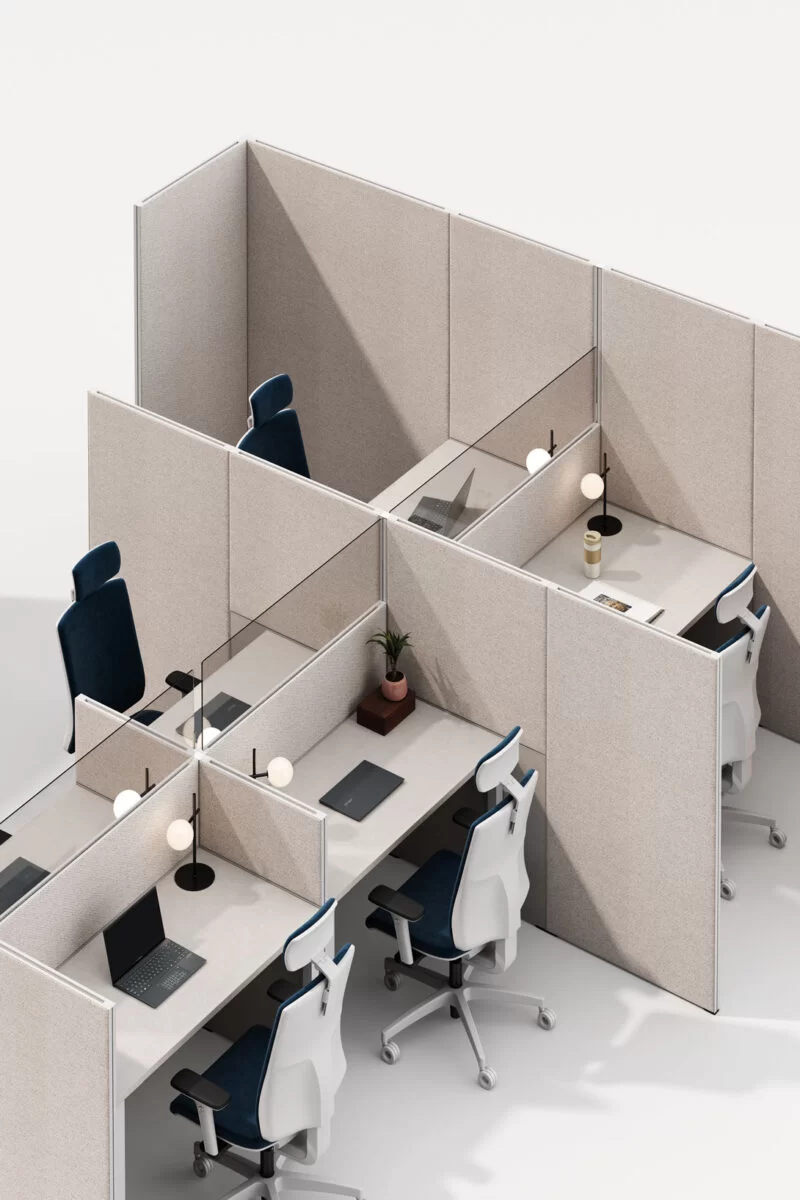
In the workplace, the applications in this sense can be truly endless: from calendar management to the recommendation of specific training courses; from the reconfiguration of layouts based on the flow of people's movements to the management of the ambiance of conference rooms (light, sounds, scents) based on the meeting goal.
In this futuristic scenario, AI doesn't neglect physical well-being. It monitors posture, by showing people how to adjust their desks and seats according to their needs, or it recommends the best time to take a break, in order to reduce stress and improve concentration.
AI from ethical point of view
The more artificial intelligence enters our lives, the more important it is to consider many other aspects besides efficiency: ethics, first and foremost, cannot be neglected.
Managing data carefully is essential, because the benefits cannot be at the expense of privacy. A balance must always be maintained between automation and observance of fundamental rights. In order for this to happen, expert input is required.
It will be the task of interior designers and architects to make this a reality, while remembering that we all love beauty, even in the office, which is a touch that only the human mind can give to a space.
 Read all





 Back to top